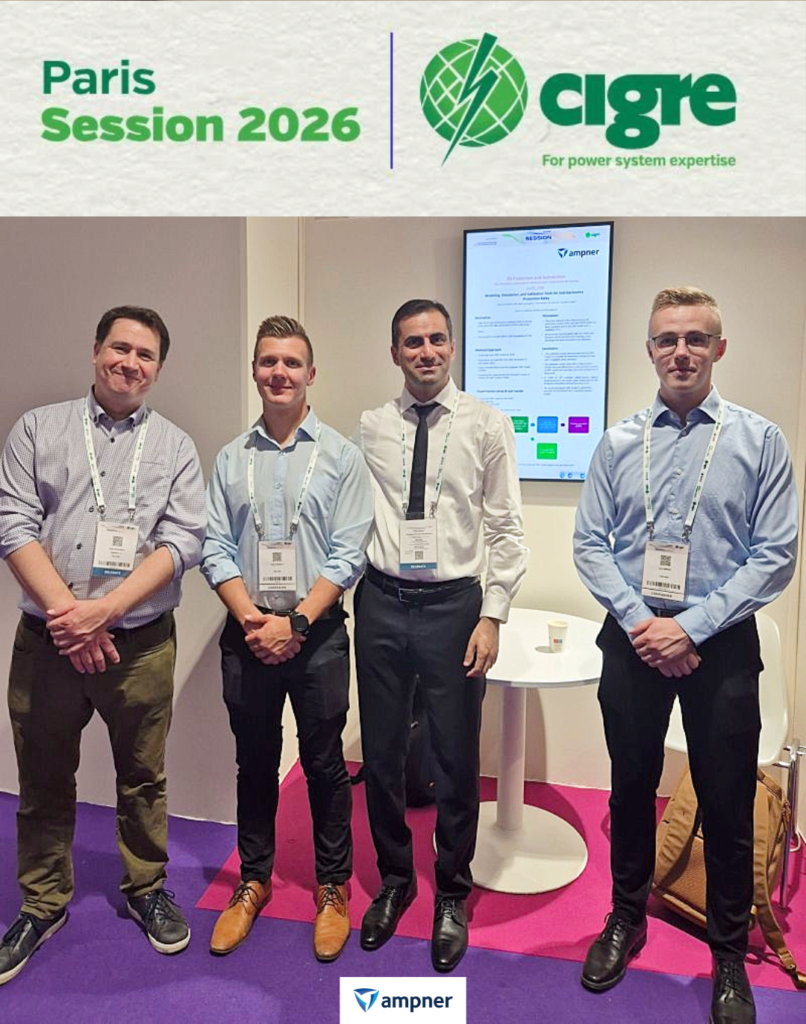
Ampner presented joint research with Fingrid and ERLPhase Technologies on the modelling and validation of sub-harmonic protection relays at CIGRE 2026 in Paris.
Why sub-synchronous oscillations matter now
The share of wind, solar, battery energy storage and hybrid power plants in the Finnish grid is growing rapidly. This shift brings new dynamic phenomena that conventional power system analysis was never designed to capture. One of the most demanding of these is sub-synchronous oscillation (SSO) – high-amplitude, poorly damped oscillations in the 5-45 Hz range, below the 50 Hz fundamental frequency.
With the growing number of doubly fed induction generator (DFIG) wind power plants, a specific form of this phenomenon has emerged: sub-synchronous control interaction (SSCI), caused by interaction between wind power plant converter control and series compensation capacitors in the transmission network. The consequences are not theoretical. High sub-synchronous voltages and currents can drive transformers and reactors into saturation and ferroresonance, and cause overcurrent, distance, differential and pole-slip protection to operate incorrectly. Nor is the risk confined to the plant where the disturbance originates – SSO can also stress equipment at neighbouring plants. A protection relay’s role is to keep the host plant’s own operation safe under these conditions.
To protect equipment against these events, sub-harmonic protection relays (SHPR) are now installed at a wide range of power plants across Finland. This protection can be implemented either at turbine level or at the plant’s substation level; not every turbine model supports it, in which case the relay has to be installed and parametrised at the substation instead. Because of the Finnish TSO’s grid code special requirements, SSO studies – EMT simulation, SSO protection analysis and dynamic impedance scans – have become an essential part of grid connection work. Critically, the EMT power plant model built for these studies must include a model of the protection relay itself.
The problem: a relay model is only as good as its accuracy
Here lies the challenge that motivated our research. Simulation models need to match the real world as closely as possible – only then can they reliably represent how the physical relay actually behaves, and only then can problems be caught before they happen. When Fingrid runs wide-area simulations to understand system-level oscillations and interactions, the results are only meaningful if the relay model in the simulation behaves like the physical relay in the field.The TSO needs to answer practical questions:
- In a given disturbance scenario, how many sites would actually have tripped on SSO protection?
- Beyond classic series resonance, which other situations – converter controller interactions, for example – could trigger the relay?
- How much generation, in megawatts, could be lost in each scenario?
Getting those answers wrong in either direction is costly. An over-sensitive model overstates the risk; an over-permissive one hides it.
What we did
What sets this paper apart from much of the existing literature on SSO protection and oscillation phenomena is its openness: we walk through both the methods and the results in detail, so the reader gets a genuine sense of what was actually done. Particularly valuable is that the simulation results were carried through to testing against the real device using COMTRADE files – allowing the accuracy of the simulation model to be genuinely verified, and the result is excellent.
Our paper, Modelling, Simulation, and Validation Tests for Sub-harmonics Protection Relay, presents a complete EMT model of a specific SHPR that is in service at several Finnish power plants, and validates that model against the physical device.
The modelling method is built on two elements:
Discrete FFT with a 5 Hz base frequency (a 0.2-second window) to resolve the sub-synchronous content of the measured currents and voltages, with a low-pass filter applied to the FFT output to smooth harmonic amplitudes and avoid spurious tripping.
BIN theory to estimate the amplitude and dominant frequency of the sub-harmonic perturbation. Each 5 Hz step – 5, 10, 15 … 45 Hz – is treated as a discrete energy bin. Where a single bin dominates, the disturbance frequency is read directly; where several bins exceed the detection threshold, the two largest are used to interpolate the dominant frequency while the amplitude is derived from all bins. In our validation, a 41 Hz perturbation was reconstructed by BIN theory at 41.00 Hz and 0.1477 kA, against 0.1499 kA measured by a much slower 1 Hz FFT – a negligible error at a fraction of the computational cost.
All three main protection functions were modelled – nominal ratio (NR), fundamental ratio (FR) and the total sub-harmonics detector (TSHD) – along with the relay’s practical features: second and fifth harmonic blocking, and cross-blocking between phases.
Two details that are easy to overlook
Two aspects of this work deserve particular attention, because they are where naive relay models tend to fail.
Out-of-band detection. A real relay must recognise sub-harmonics in the 0–5 Hz and 45–50 Hz ranges precisely so that it does not trip on them. We implemented this with a parallel 1 Hz FFT feeding purpose-built bins, mapping everything below 5 Hz to 2.5 Hz and everything between 45 and 50 Hz to 47.5 Hz. The main protection logic then ignores them automatically, as they fall outside the 5–45 Hz operating band.
Extra delay. Validation testing revealed that the physical relay carries an additional delay term in every protection mode, on top of the FFT delay and detector pick-up delay. This extra delay varies with frequency – larger near the band edges at 5 Hz and 45 Hz, and roughly constant in the mid-range – and its origin is not documented. Rather than ignore it, we characterised it empirically and reproduced it in the model using an X-Y transfer function. In TSHD mode, a fixed additional 4.025 seconds applies on top.
Validation against the physical relay
The validation process used COMTRADE files generated from EMT simulations of a power plant, injected both into the EMT relay model and into a relay test set driving the physical device – the same stimulus, two paths, directly comparable results.
Across NR tests from 4 Hz to 43 Hz, in both step-up and ramp-up cases, the model and the relay agreed on every trip decision, including correctly declining to pick up at 4 Hz and 43 Hz, outside the configured band. Timing agreement was close throughout: at 5 Hz the largest observed deviation in extra delay was 0.0568 seconds, and in the mid-range the two tracked each other to within a few tens of milliseconds. Fundamental ratio tests showed the same pattern. Second and fifth harmonic blocking, with and without cross-blocking, matched in every case.
The model was then exercised in a demanding real-world context: an aggregated EMT model of a wind power plant rated over 450 MW, where a single relay protects one aggregated main transformer. During commissioning studies for fault ride-through (FRT) and limited frequency sensitive mode (LFSM), unwanted sub-harmonics appeared in the plant model – exactly the conditions under which mis-tripping becomes a genuine risk.
What we found – including the limits
Here the results are more nuanced, and we think that nuance is worth stating openly.
In the LFSM tests, model and relay differed in pick-up timing and status, but neither tripped. In the FRT tests, the physical relay tripped in one case where the EMT model registered pick-up only, without progressing to a trip. We attribute these differences to the detection mechanism for out-of-band sub-harmonics, and they point to a broader finding: the risk of mis-tripping is higher near the band edges, and higher again when several sub-harmonics are injected simultaneously. That is a characteristic of this relay type, not of the model.
The conclusion is a practical one. The model is sufficiently accurate for the Finnish TSO to carry out system studies, and the TSO applies analysis margins for model inaccuracy when evaluating outcomes such as loss of generation. Accuracy and honest characterisation of residual uncertainty are not in tension – in protection work, they belong together.
Why this belongs at CIGRE
Ampner’s poster attracted considerable interest during the poster gala, and the conversations that followed confirmed something we suspected: this is a live problem for grid operators and developers well beyond Finland. Series compensation, converter-dominated generation and sub-synchronous interaction are not a Finnish peculiarity. The modelling approach described here is reusable, and any TSO needing to run wide-area SSO and protection studies faces the same fundamental requirement – a relay model that can be trusted.
That is also what made the event valuable in a wider sense. CIGRE offered a chance to step back from individual project timelines and look at the questions the whole industry is working on. It was genuinely energising to see the range of solutions already in service around the world, and the technologies and working practices now taking shape.
Equally valuable were the conversations themselves – with new contacts and familiar ones, with former colleagues, partners and stakeholders. Several potential avenues for collaboration and joint development emerged, and the feedback we received on the poster is already shaping how we take this work forward. This kind of open exchange is one of the core strengths of international expert events.
Looking ahead
This paper is the product of collaboration: Ampner’s modelling and simulation work, Fingrid’s experimental testing of the physical relay and system-level perspective, and ERLPhase Technologies’ expertise as the relay manufacturer. None of the three could have produced this result alone.
That is the wider point. Work like this supports Ampner’s aim of being a dependable and technically rigorous grid compliance partner in our customers’ projects – solving today’s challenges while continuously developing our own methods and expertise. But no single company can resolve the challenges of the grid transition on its own. Progress depends on open collaboration, shared experience, and a common commitment to designing and building power systems that are more reliable and more sustainable than the ones we inherited.