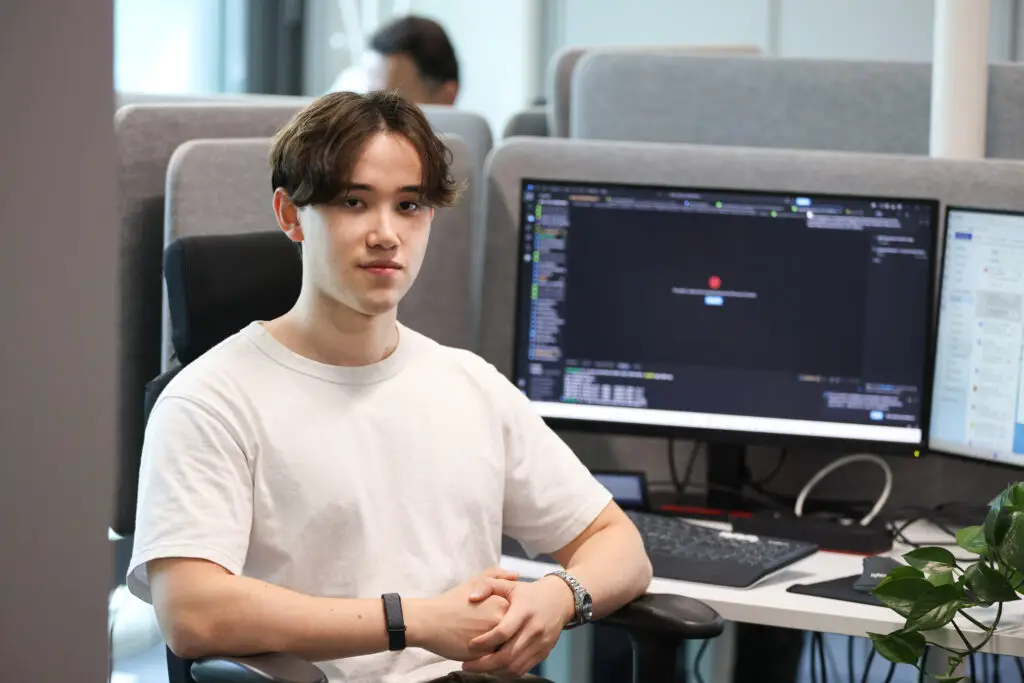
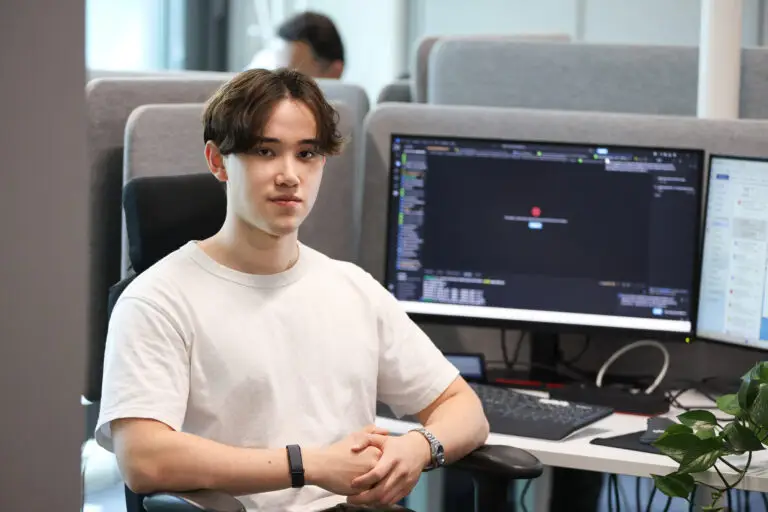
This summer, Anton joined Ampner as a summer trainee, having just completed his bachelor’s degree in electronics and electrical engineering and set to begin his master’s studies this autumn. As his summer at Ampner wrapped up, we sat down with him to hear what it’s been like to work here – and what he’s taking with him.
An Interest Sparked in Studies, Confirmed in Practice
Anton says his interest in power engineering grew out of courses he took during his studies. The field quickly felt socially meaningful to him – and that’s exactly what drew him to apply for a summer job at Ampner.
“I applied to Ampner because here you can be involved in renewable energy projects in a very hands-on way,” Anton says. Before starting, he hoped to get broad exposure to testing and modelling across wind, solar, and battery energy storage projects – and that’s exactly what happened.
His first impression of the company was a strong one. “I quickly noticed that people here collaborate closely and that the hierarchy is quite flat,” Anton recalls. What surprised him most, in a good way, was how closely he got to take part in the different stages of projects – including direct collaboration with clients.
Hands-On From Day One
Over the summer, Anton’s tasks have ranged widely. Most of his work involved testing, analysis, and documentation for wind and solar power plants as well as battery energy storage systems, but it also included preparing technical calculations and models using DIgSILENT PowerFactory, along with practical fieldwork such as soil resistivity measurements at project sites.
“My summer job at Ampner has been the most educational work experience I’ve had, and most of the tasks were completely new to me,” Anton says. His teamwork and problem-solving skills, in particular, have developed significantly over the summer.
Two projects stand out in his memory: a large wind farm development and a battery energy storage project. On the wind farm project, Anton analysed and reported test results for the first time, which taught him a great deal about grid code requirements, power engineering, and data handling. On the battery storage project, he worked closely with the client and other stakeholders and took part in consulting related to grid code compliance verification.
“Those projects stood out because I got to take on responsibility and see the concrete impact of my own work on how the projects progressed,” Anton says.
A More Realistic Picture of the Energy Sector
Theory and practice met in many ways over the summer. Anton says that before his internship, he didn’t fully grasp how many stakeholders are involved in energy projects, or how closely they work together. He’s also learned that projects consist of many stages, each of which needs to be carried out carefully before the next one can begin.
“Hands-on experience has given me a much more realistic picture of how energy projects actually progress from design to commissioning,” he says.
His skills have developed on many fronts: alongside deepening his power engineering knowledge, Anton has built his technical skills with tools like Python, Excel, and DIgSILENT PowerFactory, and gained valuable experience in project work and communication.
Support and Room to Learn
At Ampner, learning has happened by doing – with support from more experienced colleagues along the way. “I think the onboarding and guidance worked well, because I was involved in real projects right from the start,” Anton says. Help was always available when needed, which made learning new things smooth and gave him confidence in his work.
His biggest breakthroughs, in fact, came from the moments when something didn’t work out right away. “My biggest learning experiences came from situations where I made a mistake or got stuck on a problem. In those moments, I talked things through with colleagues and learned to understand the root causes of problems – and how to solve them.”
Professional, Yet Relaxed
Anton describes the team warmly. “I was welcomed very warmly, and I felt like part of the team right away,” he recalls. He describes Ampner’s work culture as professional but relaxed – help has always been just a quick question away.
The best and most rewarding part, Anton says, has been solving technically challenging problems. What stands out most are the moments spent working through a tough problem together with colleagues – and finally finding the solution.
Looking Ahead
The summer has strengthened Anton’s interest in the energy sector. His long-term career plans are still open, but after graduating, he’d like to work in expert roles within the energy industry. Right now, he’s especially drawn to battery energy storage systems for their versatility – they can support grid operation and participate in electricity markets, while also enabling more efficient use of renewable energy, for example in hybrid parks.
Anton is optimistic about the future of the energy sector: “As society continues to electrify, demand for electricity keeps growing, which increases the need for new energy solutions and grid development. I believe the industry will keep shifting further toward renewable energy production, and at the same time, energy storage and power grids will only become more important.”
He’s taking a lot away from the summer: “The most important things I am taking with me are the knowledge I have gained about renewable energy projects, power engineering, and grid code requirements, along with valuable experience in project work and using different software tools.”
The Most Memorable Moment: Turbines Up Close
Asked about the most memorable moment of the summer, Anton does not hesitate. “The most memorable moment of the summer was visiting a wind farm during testing. It was the first time I got to see wind turbines and a substation in operation on site, which helped me understand how the things we work on actually take shape physically.”